

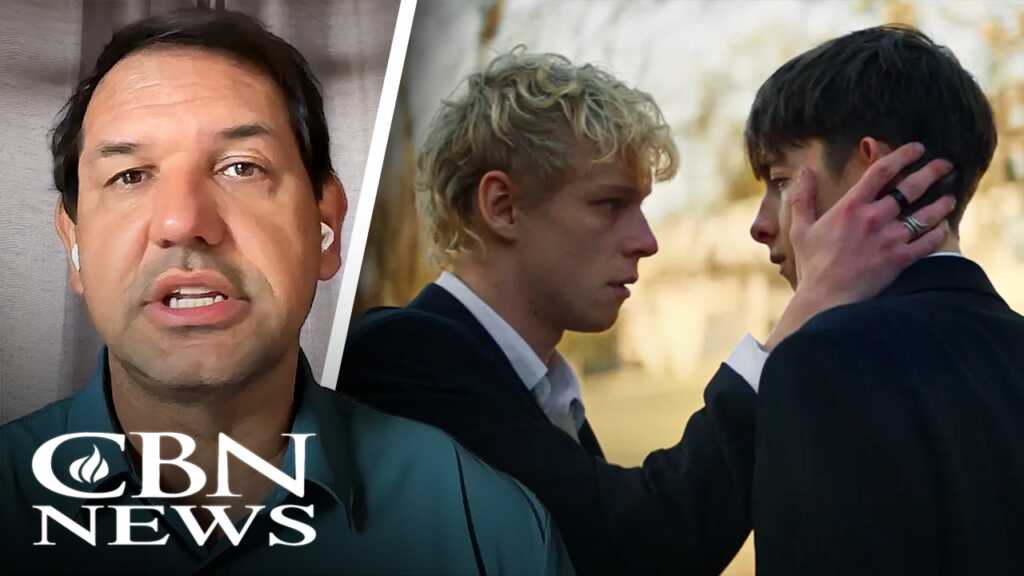

Hollywood is serving up a new movie, a film that, on its face, is demonizing a biblical sexual ethic. But, according to one apologist, the intentions behind the new movie “Leviticus” are much more sinister than that.
“This movie is a not-so-veiled attempt to basically take a broad brush swipe at all of Christianity,” author and apologist Abdu Murray told CBN News ahead of the film’s theatrical release this weekend in the U.S. and Australia.
Murray made his case by referring to a recent interview with the movie’s director, Adrian Chiarella, who said his goal with the controversial film, distributed by Neon, is to critique “homophobia” in “all its different shades.”
The movie follows two teenage boys in a small, rural Australian town. Raised in religious homes, a curse befalls the boys after they experience what looks like an exorcism-style ritual led by an angry elderly pastor in a darkened sanctuary. The teens are then plagued by a violent entity that takes on the form of whomever they desire most, meaning each other.
Whether implicit or explicit, given the movie’s title, the film’s characters presumably make references to the Old Testament book of Leviticus, which includes in it prohibitions of homosexual behavior. Leviticus 18:22 states, “You shall not lie with a male as with a woman; it is an abomination” (ESV). And Leviticus 20:13 addresses men who choose to engage in homosexual activity, declaring “both of them have committed an abomination” (ESV).
Murray argued the movie depicts a seemingly Puritanical form of “conversion therapy” — an attempt to extract from its recipient any homosexual desires — that “no one’s doing.” The movie, he said, is intentionally misrepresenting Christians in order to denigrate a biblical view of sexuality.
In actuality, the language surrounding laws and conversations on “conversion therapy” is so nebulous it has sparked legal battles.
The U.S. Supreme Court, for example, ruled 8-1 in March of this year that Colorado’s conversion therapy ban was overly broad and discriminatory. In the case, Chiles v. Salazar, counselor Kaley Chiles said the state law wrongly barred her from offering voluntary, faith-based therapy for kids, particularly on topics like gender dysphoria and confusion.
After the high court’s ruling, she said, “When my young clients come to me for counsel, they often want to discuss issues of gender and sexuality. I look forward to being able to help them when they choose the goal of growing comfortable with their bodies. Counselors walking alongside these young people shouldn’t be limited to promoting state-approved goals like gender transition, which often leads to harmful drugs and surgeries.”
Speaking on the seemingly intentionally vague language on “conversion therapy,” Murray — like Chiles — pointed out that harmful treatments like shock therapy are no longer practiced and agreed the verbiage has been used to attack the church and a sexual ethic based on the Bible.
“[The language] paints [with] such a broad brush, that it essentially would either socially penalize or legally criminalize any form of a sexual ethic from the Bible, which is a moral statement,” he said.
As for promoting a scriptural understanding of sexuality, Murray said, “The Bible is not interested in making us sexually normal; it’s interested in making us sexually moral, because there’s just as much [of an] indictment of heterosexual sin as there is of any other kind of sin as well.”
He went on to explain what — in part — makes marriage so “sacred”:
Our diversity [as males and females] is so important in the union of marriage and sexual behavior within the union of marriage, because it [gives us] a chance to reflect the divine. But there’s another thing as well … that’s really important here. Not only are we all inherently sacred because we reflect God’s image, not only is marriage inherently sacred because it gives us the ability of a unity of diversity within the bond of matrimony, but it also reflects something that’s coming.
And that … is the ultimate marriage. Yes, the world is going to be judged, but there’s going to be a wedding between two diversities: God, who is everlasting, never beginning, never ending, absolutely pure, and His bride [humanity], which had a beginning, which was adulterous in many of her ways, but is now cleaned up and redeemed and beautified and brought together.
“But the way to think of it better is not that the Bible prohibits something that dusty old men found icky in a dusty old time and used God to baptize their bigotry with,” Murray continued. “It’s not that God is just prohibiting something; God is protecting something. He’s protecting the sacredness of every human being and the sacred gift that marriage is that allows us one form of expression of unity of diversity, which foreshadows that which is to come.”
In response to a film denigrating Christianity and a biblical view of sexuality, Murray urged Christians not to feel discouraged.
He said believers, through Scripture, “have a beautiful story to tell about the redemption of biblical sexuality.”
Although Murray did not suggest Christians should see the movie, he did acknowledge it will be a subject of conversation and encouraged believers to use the film’s release as an opportunity to talk about the Gospel and what God has to say about sexuality.
“We have a message of hope, and sometimes, Hollywood gives that message of hope by accident,” he said. “The Gospel is such a powerful story that sometimes we tell it by accident.”
Watch our full conversation with Murray in the video above.
As the number of voices facing big-tech censorship continues to grow, please sign up for Faithwire’s daily newsletter and download the CBN News app, developed by our parent company, to stay up-to-date with the latest news from a distinctly Christian perspective.