

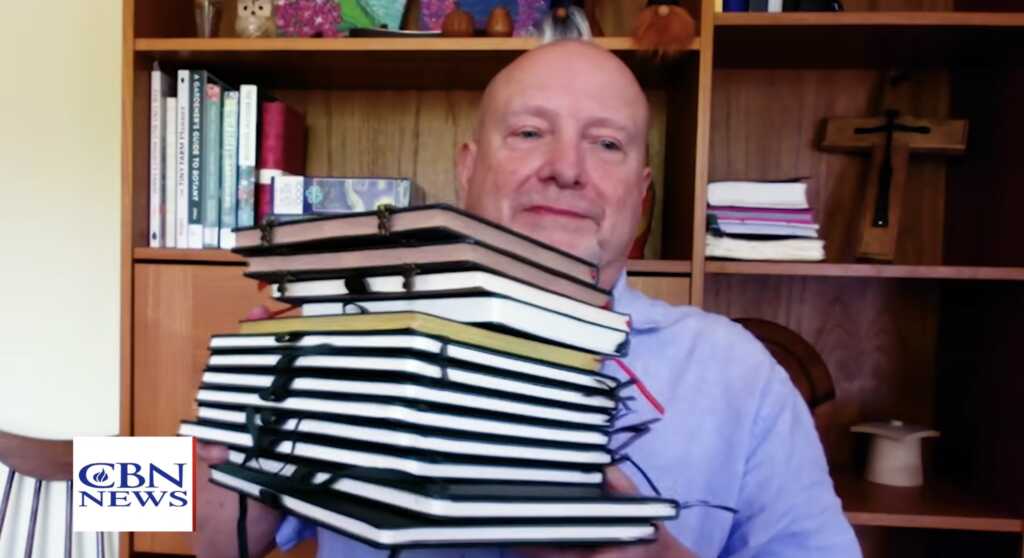
It took Don Ashley about 210 hours over eight months and 15 days to write his own handwritten copy of the New Testament.
Ashley, a recently retired university administrator who relocated from Anchorage, Alaska, to farmland in Arkansas, posted to social media this month that he’d just completed the project — an endeavor he said he began “on a whim” on Jan. 5.
View on Threads
But what started as an impulse quickly turned into what he called “a mission.”
“In all these life transitions,” he told CBN News, “this really served as an anchor for my soul.”
The idea, he explained, was born out of a work trip to the Society of Biblical Literature, a 146-year-old learning society dedicated to the academic study of the Bible and other ancient writings.
When he was at the meeting in San Diego, Ashley saw a display of the Dead Sea Scrolls, a collection of roughly 1,000 ancient Jewish manuscripts dating from the 3rd century B.C. to the 1st century A.D. They were discovered in the 1940s and 50s.
“I was so impressed by the artistry required … that I wanted to experience something about what the ancient scribes experienced,” Ashley said.
The average American spends about two-and-a-half hours per day on social media. For teenagers, that number is nearly doubled, spending roughly five hours every day on social media apps. And 41% of teens who reported the highest social media use rated their mental health as poor or very poor, according to data from the American Psychological Association.
Much of that time is spent doomscrolling, a term that first broke into the American lexicon through Twitter in 2018 and was officially added to the dictionary in late 2020. The concept became pretty commonplace at the height of the COVID-19 pandemic, when Americans of all ages were stuck at home spending an outsized portion of their days scrolling content on their phones.
Doomscrolling, for the uninitiated, is the habit of spending excessive time online browsing through often negative, depressing, and alarming news content. Needless to say, dedicating a great deal of energy to that kind of content can quickly become distressing and take a significant toll on users’ mental health — particularly if they have no belief in a sovereign God who promises to work together all things to the good of those who love Him (Romans 8:28).
As for Ashley, he felt handwriting the Bible was a better, more profitable use of his time.
“I think the idea that, instead of doomscrolling, maybe you could do something more useful with your time,” he said. “The world is so fast-paced now, maybe it appeals to the idea of slowing down.”
The process was deeply cathartic for Ashley, who is currently recovering from a significant back surgery. He likened the project, in a spiritual sense, to “a starving man being invited into a banquet.”
“I made mistakes on this page and I didn’t worry too much about the mistakes,” he said, holding up a page from his journal where he’d marked over some errors. “I just lined through them and kept going.”
When it was all said and done, Ashley noted that — while he didn’t walk away with any new theological revelations — it was spiritually encouraging to physically experience Scripture in a new way.
“I’ve experienced the Bible with my mind for my whole career and since my initial conversion experience in 1985,” he said, “but I wanted to experience it with my fingers. Putting a pen to paper is a different experience than reading it.”
Watch our full conversation with Ashley in the video above.
As the number of voices facing big-tech censorship continues to grow, please sign up for Faithwire’s daily newsletter and download the CBN News app, developed by our parent establishment, to stay up-to-date with the latest news from a distinctly Christian perspective.