

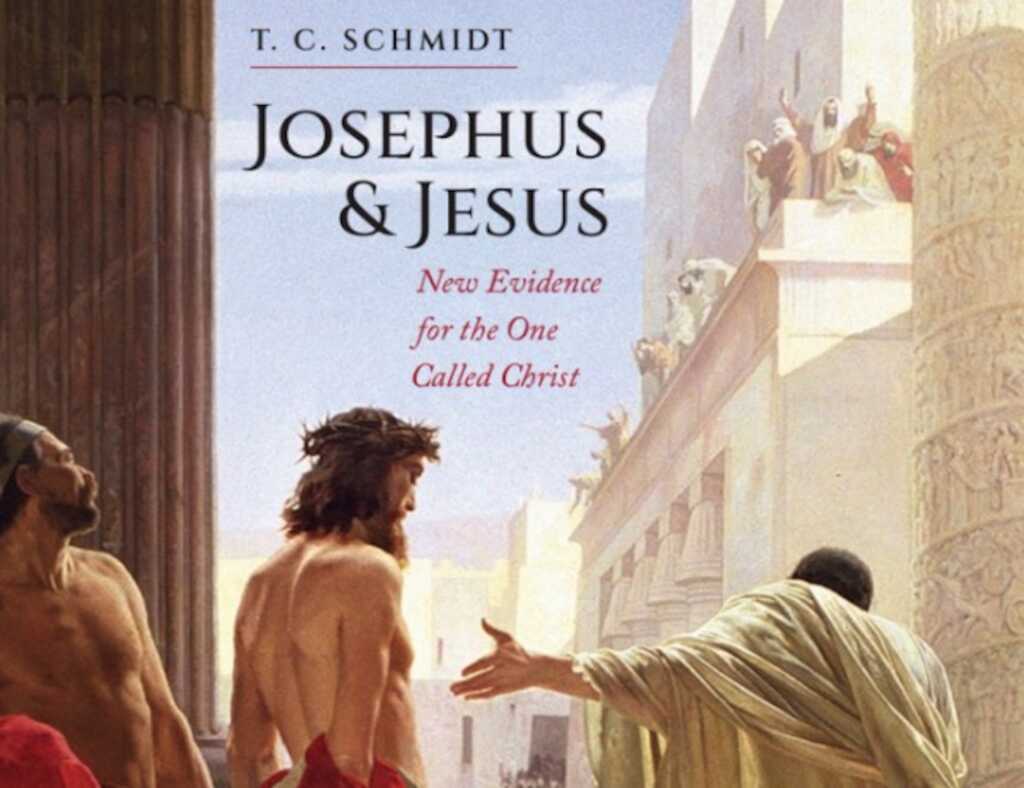

A college professor is revealing research he says helps corroborate early, extrabiblical writings about Jesus.
Dr. Thomas C Schmidt, associate professor of religious studies at Fairfield University, recently released, “Josephus & Jesus: New Evidence for the One Called Christ,” a book he believes helps set the record straight on Flavius Josephus’ writings.
“Josephus is one of the most important sources we have on the New Testament because he mentions so many people that are discussed in the New Testament, folks like Herod the Great, Herodias, Pontius Pilate, Caiaphas, Herod Agrippa, John the Baptist,” Schmidt said of the Jewish historian. “He talks about all these people, and he also talks about Jesus.”
But the professor said Josephus’ Jesus passage is “very controversial,” because many scholars have questioned the authenticity of this particular portion of the writings.
“They’ve thought that Christians tampered with it later on,” he said. “They thought Josephus didn’t actually write this. Josephus is writing in the first century. He was born in Jerusalem, raised in Jerusalem. So if he does tell us about Jesus, it would be the earliest witness to Jesus outside of Christian writings, which should just make it extraordinarily valuable and interesting.”
Schmidt said the majority position among scholars in the 19th century was that Josephus didn’t write any of the words about Jesus attributed to him and that the text was “completely fraudulent.”
“But then this brilliant scholar who was translating Josephus’ works, he started noticing that there were just many phrases in this account of Jesus that are odd phrases, but that Josephus himself uses many times elsewhere,” he said. “The scholar’s name was Henry Thackeray, and he turned the tide of arguments so that scholars started thinking, ‘Well, OK, clearly Josephus did say something about Jesus, but maybe Christians doctored it later on,’ because the belief by scholars was that what Josephus said was just too positive, too glowing to be written by a non-Christian.”
In the 21st century, scholars again looked at Josephus’ stylistic choices and found even more parallels between what was written about Jesus and Josephus’ other writings.
Schmidt conducted his own investigation for the book — and came to some fascinating conclusions.
“I exhaustively leverage these databases, and I show that every single phrase in the paragraph can be indexed back to Josephus in some way or another,” he said. “It sounds exactly like him. The turns of phrase, the vocabulary, everything sounds like Josephus.”
Schmidt said he also noticed something else in the passages some claim are “too pro-Christian.” One comment by Josephus is that Jesus worked miracles — something widely seen as supporting the Christian narrative. Schmidt said it’s more complex.
“Josephus says that Jesus worked miracles,” he said. “But the original Greek word is not quite so positive. It does mean ‘supernatural deeds’ but maybe we could better translate as ‘paranormal deeds.'”
Schmidt continued, “Josephus is acknowledging that Jesus worked supernatural deeds, but he’s unclear where the source of Jesus’ power is coming from. He doesn’t know if it’s malevolent, demonic — if it’s divine. In other words, Josephus looks like he’s assessing Jesus the same way the non-Christian Jews in the Gospels are responding to Jesus’s miracles.”
The academic said he started his journey writing “Josephus & Jesus: New Evidence for the One Called Christ,” on a quest to figure out how the Jesus passage had been changed by Christian scribes, adding that he initially agreed with the position that it wasn’t original.
“I was hoping that I could figure out what was changed so I could reconstruct what Josephus said,” he said. “But when I started looking at the results of these database searches, I became convinced that really the whole thing comes from Josephus.”
The resurrection is just one of the issues Schmidt addressed in his research.
“Traditionally, that part of the passage is translated as Josephus saying Jesus appeared alive again on the third day,” he said, noting that understanding the original language helps comprehension. “So, in other words, Josephus is not claiming that Jesus was resurrected. What he’s reporting is that the first disciples of Jesus claimed that Jesus was resurrected.”
And considering Josephus likely had access to people who put the disciples to death, he had remarkable first-hand information.
“Josephus didn’t just know people who knew the apostles; he knew people who knew Jesus, who were at his trial,” Schmidt said. “That’s the argument I make towards the end of my book. … I did not intend my book to be an argument in favor of Josephus’ passage being totally authentic, but that’s where the evidence led me.”
You can download, “Josephus & Jesus: New Evidence for the One Called Christ,” for free.
As the number of voices facing big-tech censorship continues to grow, please sign up for Faithwire’s daily newsletter and download the CBN News app, developed by our parent establishment, to stay up-to-date with the latest news from a distinctly Christian perspective.